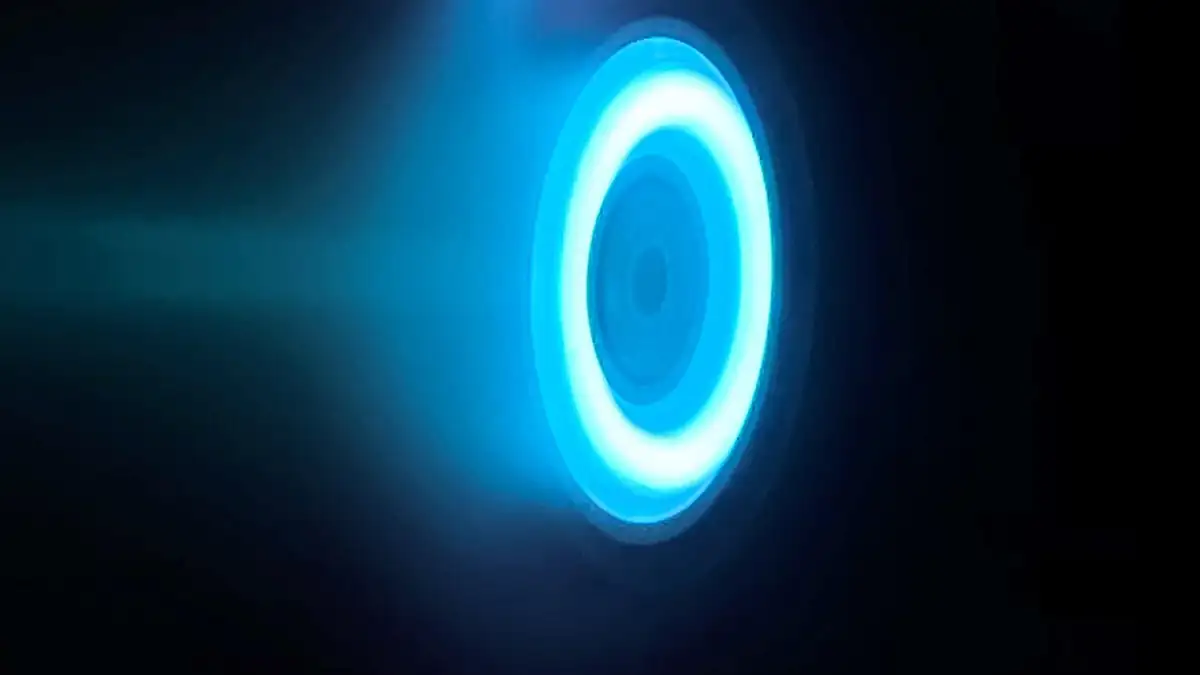

NASA’s Psyche mission has shifted toward nearly continuous electric propulsion after a successful Mars gravity assist. JPL says the spacecraft began the new operating pattern on September 28 and is aiming for the metal-rich asteroid Psyche in summer 2029. Gentle thrust sustained for months can add up to major changes in velocity.
How Hall thrusters work
Unlike chemical engines that provide brief high-thrust burns, Hall thrusters use solar electricity to accelerate xenon ions. JPL describes an exceptionally small force that becomes useful because it acts for so much of the cruise.
The route toward the asteroid
Engineers also manage a tiny torque produced by the propulsion system. Psyche has not reached its asteroid and is not yet conducting the main orbital survey. The proposed image shows a genuine thruster test, not artwork disguised as a photo taken in space.
What electric propulsion cannot do
NASA says the thrusters will operate for much of the cruise to 2029, with pauses for communications and spacecraft operations. This is not acceleration like a car: speed builds gradually in space. Electric propulsion achieves efficient use of propellant over long periods, trading strong instantaneous force for prolonged operation.