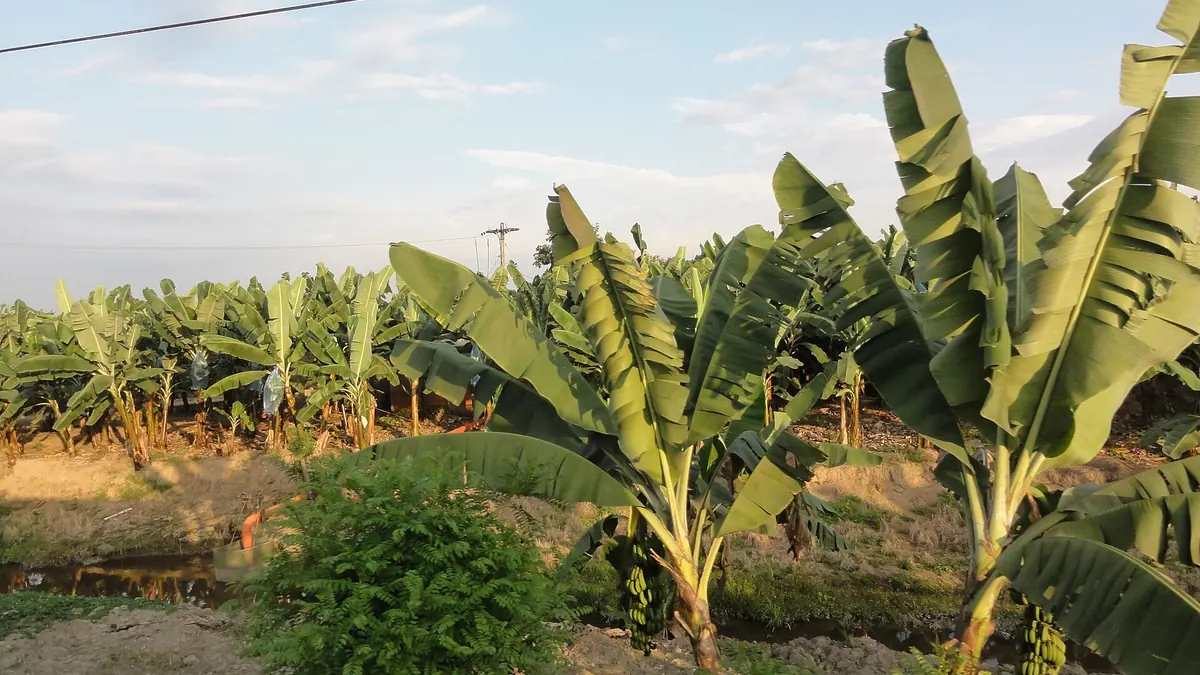

The floods in Santa Rosa, in Ecuador’s El Oro province, were more than a weather emergency for banana growers. Water overflowing from the Medina stream reached land previously associated with Fusarium tropical race 4 (TR4), a serious plant pathogen. That raises a question with consequences for farms and export supply chains: could floodwater undermine efforts to contain the disease?
Source: www.ecuavisa.com: Floodwaters reach Ecuador banana farm linked to Fusarium: what is at risk?.
What happened on the ground
Ecuavisa reported that six hours of intense rainfall caused the stream to overflow around El Quemado. At least 1,000 hectares of banana and other farmland were flooded, including a property where the fungus had been detected about a year earlier and ten neighboring banana farms. Water reportedly crossed the protective barriers around the affected property and reached a depth of roughly 1.5 meters inside it.
These are figures reported on October 20, not a final crop-loss assessment. Nor do they establish that the fungus has spread to nearby farms. Confusing a risk of transmission with a confirmed new outbreak could cause unnecessary panic and undermine the credibility of genuine warnings.
Source: www.ecuavisa.com: Floodwaters reach Ecuador banana farm linked to Fusarium: what is at risk?.
Why Fusarium TR4 is such a concern
TR4 is a soil-borne fungal pathogen that can cause a devastating disease in banana and plantain crops. Its persistence and the difficulty of removing it once established are major reasons for strict controls. The UN Food and Agriculture Organization highlights how contaminated soil, water, equipment and planting material can contribute to movement of the pathogen.
Flooding matters because it can break physical separation between a monitored plot and surrounding land. But scientists and plant-health authorities still need field inspections, sampling and laboratory analysis to determine whether a new transmission event actually occurred. A photograph of standing water cannot answer that question.
Source: TR4 Basics TR4 Global Network Food and Agriculture Organization of the United Nations.
Why the story reaches beyond one district
Banana cultivation supports livelihoods in El Oro and forms part of Ecuador’s wider export economy. Even an unconfirmed biosecurity threat can generate concern among farmers, employees and trading partners. Responsible reporting should focus on what steps are taken to assess neighboring plantations and whether movement controls are updated.
Producers should follow instructions from the competent plant-health authority, particularly around moving soil, tools, machinery or planting material. Readers should look for official inspection outcomes rather than treating online claims about infected farms as established fact.
What is known: flooding breached containment barriers at the reported property. What remains unverified: whether the fungus has actually spread to any additional farm. The distinction will be central to future updates.
Source: TR4 Basics TR4 Global Network Food and Agriculture Organization of the United Nations.