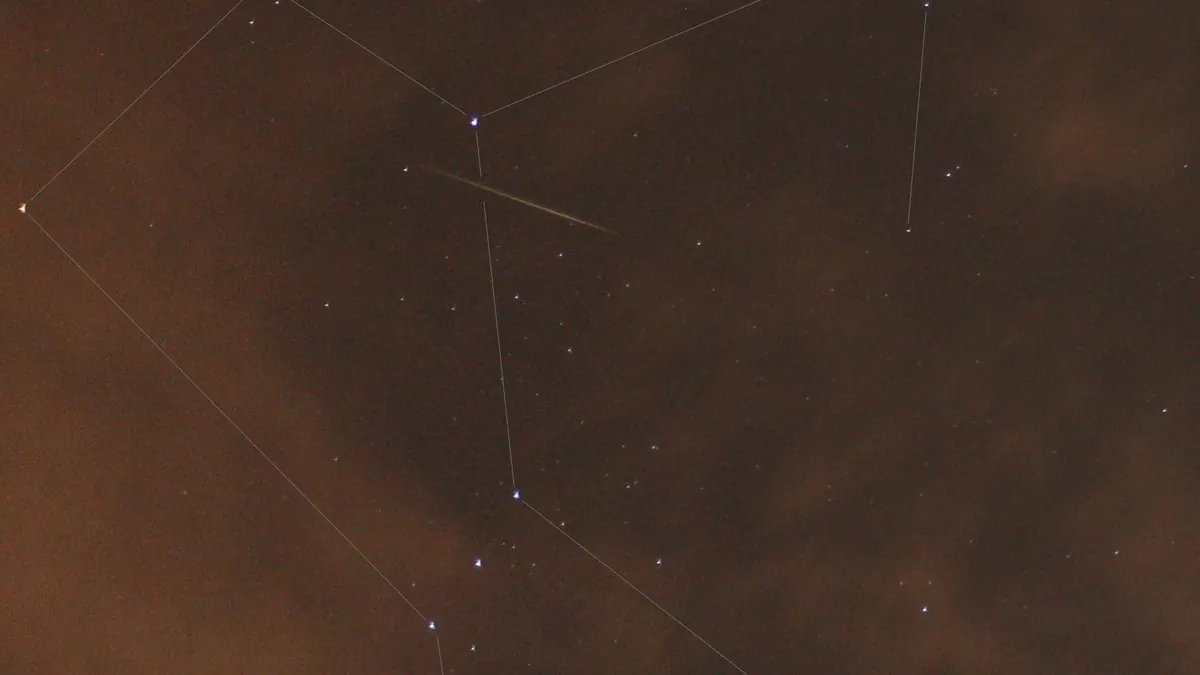

Late October offers an event that requires no telescope: the Orionid meteor shower. NASA lists its 2026 peak for the night of October 21 into the morning of October 22. The prospect of watching bright streaks race across the sky is exciting, but one major factor could limit the view this year: moonlight.
Source: What s Up: October 2026 Skywatching Tips from NASA - NASA Science.
What causes the Orionids?
The shower occurs when Earth passes through a trail of tiny particles left behind by Halley’s Comet as it orbits the Sun. These fragments enter our atmosphere at high speed, creating luminous streaks that we call meteors. They are not stars falling out of the sky and are generally harmless to people watching from the ground.
The shower is named for the constellation Orion, near the point from which the streaks seem to radiate. Meteors can nevertheless appear across a much wider area of sky. Observers should avoid staring at a single point and instead take in as much darkness as possible.
Source: Orionids - NASA Science.
How many meteors might be visible?
NASA describes a typical rate of around 10 to 20 meteors per hour under ideal dark skies. That does not promise the same experience from a city balcony or during a cloudy hour. Light pollution, weather and moonlight can all reduce the number visible to an observer.
In 2026, the waxing gibbous Moon is bright enough to wash out many fainter streaks. NASA recommends looking during the hours before dawn after moonset, when the sky has a better chance of being dark. Exact moonset times vary by location; a schedule for one city should not be presented as universal.
Source: Orionids - NASA Science.
Tips for watching from either hemisphere
Choose a safe, open location away from bright artificial lights. Give your eyes time to adapt, reduce phone-screen use and be patient. Meteors arrive irregularly, so a quiet spell does not mean the shower has stopped. Binoculars and telescopes are not necessary; a reclining chair can make longer viewing sessions more comfortable.
The Orionids are visible from both hemispheres, including Ecuador, but local cloud cover determines whether skywatchers will see anything. Checking the weather is just as important as marking the peak date.
What astronomy can confirm: the shower reaches its expected maximum on October 21–22. What no article can guarantee: the number of bright streaks any individual will see from a particular street, city or night.
Source: What s Up: October 2026 Skywatching Tips from NASA - NASA Science.
Sources and verification date
- Orionids - NASA Science — 2026-10-20.
- What s Up: October 2026 Skywatching Tips from NASA - NASA Science — 2026-10-20.