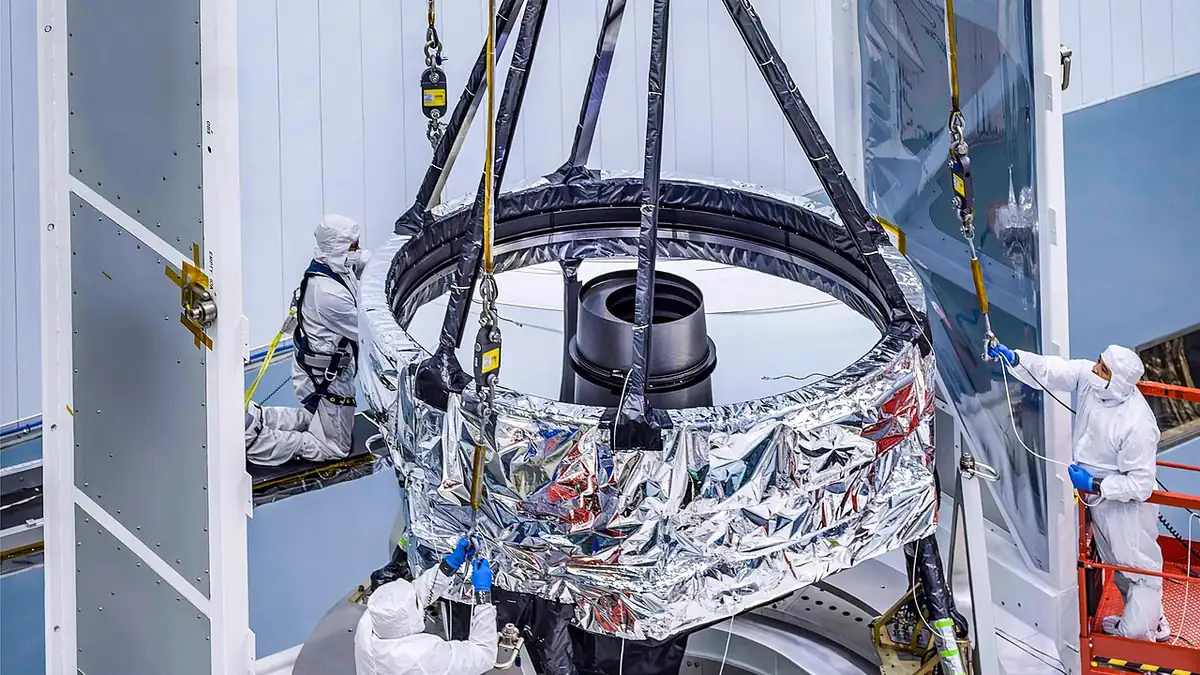

NASA announced on October 22 that the Nancy Grace Roman Space Telescope had entered a final science-commissioning phase after successful instrument and observatory checks. The mission team is refining image quality and calibration before routine science operations. Testing success is an operational milestone, not yet a published scientific discovery.
What science commissioning entails
Roman is built to survey vast areas of the sky quickly. Before its images become reliable scientific measurements, researchers must distinguish actual changes in astronomical sources from subtle differences introduced by the instruments.
Checks before observations begin
NASA’s commissioning work covers sensitivity, sharpness, pointing and consistency. That precision matters: otherwise instrumental variation can masquerade as a variable star or faint signal. The suggested assembly photograph is archived mission hardware, not an image taken in orbit.
What to expect from Roman
A camera surveying huge parts of the sky can catch rare phenomena through the scale of its mosaics, but its measurements depend on repeatable calibration. NASA says guidance and focusing checks have performed well even against dense stellar backgrounds. This is promising engineering progress, while the mission still has to complete validation before producing definitive scientific findings.