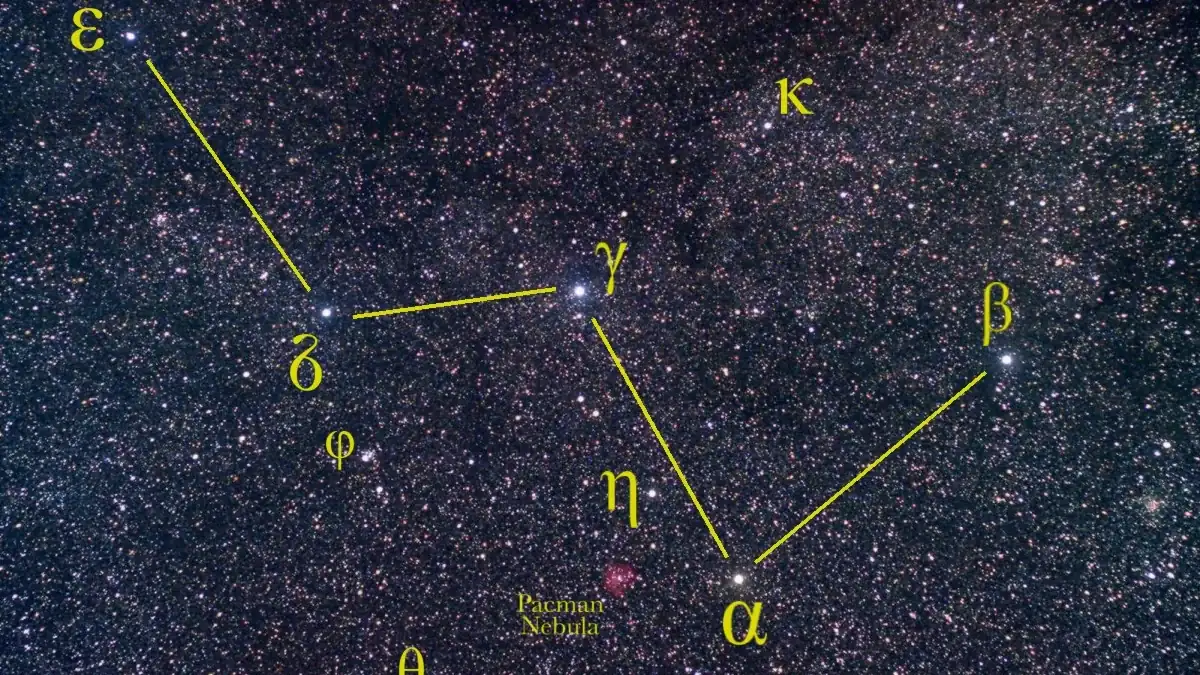

An October 21 astrophotography feature highlights faint ionised-oxygen structures in Cassiopeia, but their physical origins remain uncertain.
A familiar constellation still has hidden structure
NASA’s Astronomy Picture of the Day on October 21 featured faint structures in Cassiopeia that ordinary photographs are unlikely to reveal. APOD explains that the observing team combined about 100 hours of exposure with an oxygen-sensitive filter to bring out three extremely dim objects near the well-known nebulae IC 59 and IC 63.
Gamma Cassiopeiae illuminates surrounding gas and dust. Some of the material glows through hydrogen emission; elsewhere dust scatters starlight. The new features highlighted through ionised-oxygen emission raise questions about the processes creating them.
Detection is not the same as identification
One feature may be associated with a bow shock where material is compressed around a moving star. Another might be a planetary nebula, but supporting observations—such as finding a suitable central white dwarf—would be needed to establish that explanation. NASA describes these possibilities as hypotheses, not settled classifications.
Deep astrophotography relies on long observing times and specialised image processing. Colours may be assigned to particular filters or wavelengths and need not correspond to what an unaided human eye would see.
The vital image-rights distinction
The APOD image explicitly credits and copyrights Louis Leroux-Géré, Thibault Rouillée, Vincent Martin and Cédric de Decker. It must not be copied without their permission. This article instead proposes a separately licensed CC BY 3.0 photograph of the Cassiopeia constellation, with a caption explaining it is not the October 21 discovery image.
Sources and documents
Editorial verification: based on reporting available October 22, 2026. Recheck developments before release.